
What Does it Mean to Partition Real Estate in a Lawsuit?
A partition action is a legal mechanism that allows one co-owner of a legal property to request that a court either divide or sell the property, even when other co-owners do not agree. This action constitutes a last resort when a property jointly owned becomes contentious,s and the co-owners cannot agree on any other course of action.
Partition actions originated from property law principles recognizing that co-owners should not be compelled to maintain a relationship when one party desires to exit.
In several regions, unless the involved parties have contractually waived it, every co-owner has the legal right to seek partition.
For instance, consider a scenario where you and someone else possess a piece of real estate, like a house, land, or a piece of commercial property, and you cannot agree on how to divide it.
You (or any other co-owner) have the legal right to send a request to the court to have the property divided or sold and have the proceeds evenly distributed or divided into a number of parcels.
Definition & Legal Foundation of a Partition in Real Estate
Legal Definition & Nature
- A partition action is a civil lawsuit brought by (or on behalf of) a co-owner of property who seeks to terminate the joint interest by dividing the property (partition in kind) or selling it (partition by sale).
- The co-owner initiating the partition is often referred to as the plaintiff or petitioning party, and the other co-owners or interested parties are named as defendants.
- The court must include all persons with a recorded or claimable interest in the property, including co-owners, lienholders, mortgagees, and any other person with a legally recognized interest.
- Unlike many civil actions, partition cases usually proceed in equity rather than giving the right to a jury for the partition issue (though some ancillary issues might go to a jury).
Underlying Principles & Rights
- The law respects that co-ownership (a concurrent estate) may become untenable, and the partition remedy ensures that no co-owner is indefinitely shackled to an unwanted joint position.
- At the same time, courts often balance equity by considering which remedy (division or sale) is fair under the circumstances. The objective is not to favor one party unduly but to arrive at a just outcome.
- In certain states, reforms have added protections for “heirs’ property” (property inherited by multiple people) to reduce the risk of forced sales that hurt disadvantaged co-owners. Under the Uniform Partition of Heirs Property Act (UPHPA), many states require co-owners to offer to buy out the petitioner, prefer partition in kind when possible, and strengthen notice obligations.
Common Scenarios Leading to Partition Actions
Partition actions often arise from disputes in familiar contexts. Some typical situations include:
Heirs or Inherited Property
When a property owner dies, leaving multiple heirs, those heirs may inherit fractional interests (especially in common tenancy). If they disagree about whether to keep, rent, or sell the property, a partition action may follow.
In jurisdictions with UPHPA protections, co-owners may have stronger rights to retain the property or to prevent a forced sale by insisting on buyouts or favoring a division.
Co-owners Who Disagree (Business Partners, Friends, Investments)
Two or more people may jointly invest in real estate. Over time, disputes may arise: one party wants to liquidate, while the other wants to hold. If negotiations fail, one may pursue partition.
Divorce or Separation (Marital Property)
In some marriages, property is held jointly. Upon divorce, one spouse may seek to terminate co-ownership and force a sale, even when the other spouse disagrees. The availability of a partition in that context may depend on the state’s family law or marital property rules.
Long-Standing Conflict over Use or Expenses
Perhaps one co-owner lives on the property and handles all maintenance, while the other refuses to help. Over time, resentment builds. A partition may be used to resolve ongoing financial or use conflicts.
Partition by Sale vs. Partition in Kind (and Other Alternatives)

A significant conceptual divide in partition law is how the court should resolve the dispute — by dividing the property or selling it. Let’s go through the options.
Partition in Kind (Physical Division)
- According to this method, the court physically separates the property among co-owners based on their ownership interests (e.g., when one co-owner owns 60 percent of the property and the other 40 percent, they receive land parcels in those proportions).
- This is usually the preferred option when the property can be fairly divided without negatively affecting its market value.
- However, not every real property can be divided; a single-family house or a building can be physically challenging or unfair to divide. In such cases, courts will typically refrain from dividing and lean toward the sale.
- Courts also consider whether division would cause one party to lose value or utility (for example, if dividing would deprive one party of access or amenities).
Partition by Sale
- More commonly used, particularly when dividing something, would be impractical to do or cause unreasonable damage to the property’s worth. The court directs the sale of the property, whether public or private, and the co-owners share the net proceeds.
- The sale may be conducted by a court-appointed official, for example: a ‘special master’, ‘commissioner’, or ‘referee’, or the co-owners may agree on a more informal method themselves.
- The proceeds from the sale are first used to pay off liens, mortgages, and taxes, as well as the costs of sale, court costs, and commissions. After that, the remaining amount is divided among the co-owners according to their respective shares, with the proceeds claimed, of course, and possible equalization adjustments made through credits or debits. This compensation is primarily because one or more of the parties may have contributed more toward the upkeep or improvement of the property.
- In some jurisdictions, partition by appraisal is an alternative. One or more co-owners wish to buy out the others at the appraised value voluntarily, rather than forcing a sale. This works when all parties agree to that path.
Which is preferred & when
- Many courts first consider whether a partition in kind is feasible without reducing value. Only if division is impractical or unjust will they order a sale.
- State statutes or local rules may require or mandate a preference (e.g., favoring division over sale unless necessary).
- In states with UPHPA or similar reforms, courts may be required to offer co-owners alternative remedies (e.g., buyout) before ordering a sale.
Costs, Timelines & Possible Outcomes
Before pursuing or defending a partition action, it is necessary to assess the procedural and financial risks involved.
What are the Costs of a Partition Action?
- One of the most important costs to consider is attorney fees and litigation costs. Hiring a lawyer, creating legal documents, managing discovery, attending hearings, and collaborating with expert witnesses can be expensive.
- Courts often appoint a neutral to oversee the process. Most of the time, the costs of legal disputes are deducted from the sale proceeds, partitioned, or split among the parties.
- Another cost to account for is the Title Search and Surveying, which also involves identifying interests, boundaries, easements, and encumbrances.
- Additionally, appraisal valuation expenses are involved in determining fair market value when co-owners are involved to settle a value dispute.
- These do not account for court filing fees and administrative costs, which vary from one jurisdiction to another. In Massachusetts, for example, the Land Court has a baseline charge plus additional and per-summons fees.
- Proceeds from the sale also incur costs, such as broker commissions, closing costs, and property repairs.
- Lastly, unused Taxes, Liens, Mortgages, and Payoffs are legally implemented, which balances outstanding mortgages or liens placed on the property before it is divided and distributed.
Some of these costs will be deducted from the proceeds before the remaining fees are split among the co-owners.
What are the Steps in a Partition Action?
- A partition case can span months or years, depending on its complexity, the court backlog, and disputes over title, contributions, or valuation.
- Much of this time can be circumvented if co-owners negotiate or settle early. Many partition matters are resolved before the trial proceeds to its full extent.
- Steps typically include filing, service on defendants, responses and discovery, appointment of a commissioner/referee, property inspection/valuation, possible hearings or trials, and, if a sale is ordered, marketing and closing.
Possible Outcomes of a Partition Suit
- Partition by sale: Property sold, net proceeds divided.
- Buyout/settlement: One party buys out the other (s) (either through negotiation or a court-ordered appraisal).
- Adjustments & credits: The court may award more to a party who contributed more (for example, paid for improvements, taxes, or maintenance).
- Dismissal or settlement without partition: The parties may reach an agreement, or failure to prosecute may result in dismissal.
In unfavorable circumstances, the co-owner who paid or contributed less may end up with a smaller share or even lose out altogether if the sale proceeds are insufficient after costs.
When Court Intervention Becomes Necessary
While litigation is costly and adversarial, there are cases in which court intervention is the only viable option.
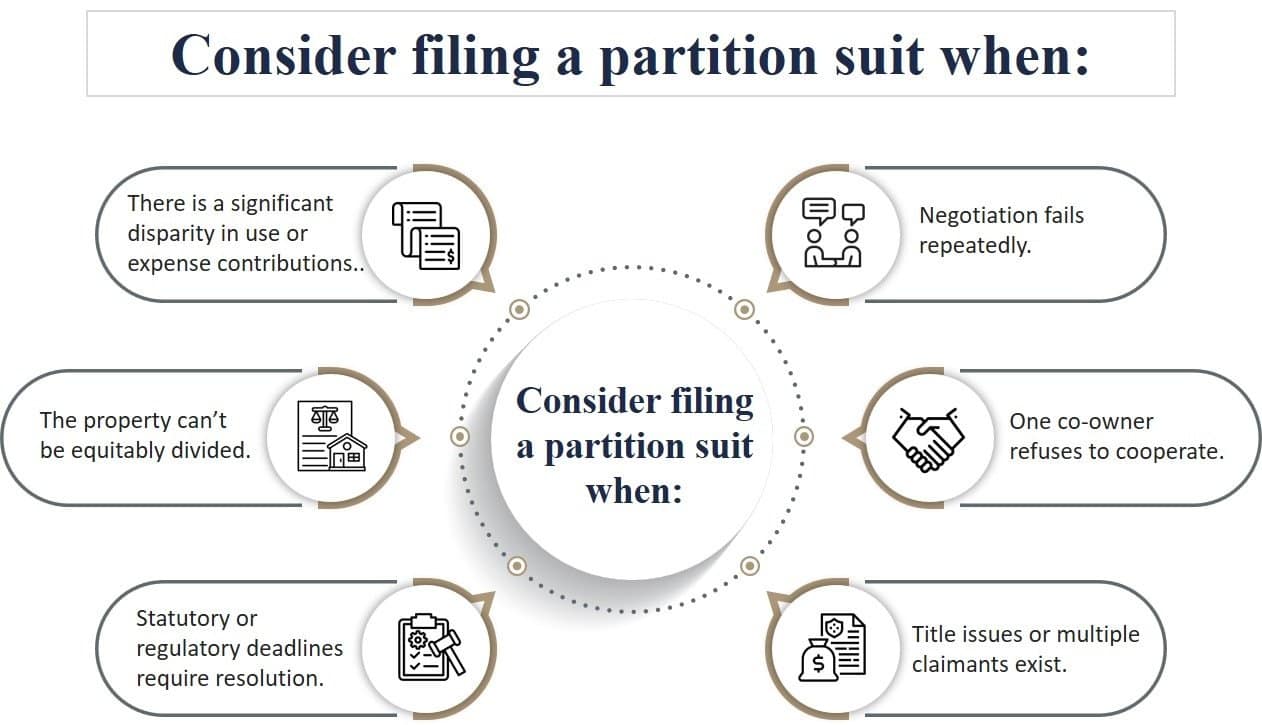
You might consider filing a partition action when:
- Negotiation fails repeatedly. The co-owners are unable to agree on the terms of sale, division, or buyout.
- One co-owner refuses to cooperate and acts as an obstacle to the property’s administration.
- Title issues, multiple claimants, undisclosed heirs, lienholders, or ambiguous ownership require judicial determination.
- There is a significant disparity in use or expense contributions — one co-owner uses the property heavily or pays disproportionate costs.
- The property can’t be equitably divided: forced sale may be the only fair solution.
- Statutory or regulatory deadlines require resolution: in some states, it must be brought within specific time periods.
The courts would rather have the co-owners attempt to settle first (through negotiation, mediation, or arbitration). If that fails, a partition action allows the court to impose a fair solution.

Schedule a Consultation Today
Partition actions can be immensely helpful when shared property burdens one or more co-owners. This can be an effective action when property becomes a burden rather than a benefit. However, the actions can be costly, time-consuming, and risky. In such instances, mediation is often the better route, as it reduces the likelihood of a trial.
Therefore, don’t attempt to handle a co-owner dispute involving real property on your own. Seek our legal expertise in real estate and partition law. Schedule a consultation with our partition action attorney today.